
My general research interests are in the field of climate change and climate variability on time scales ranging from seasonal-interannual (El Nino), centennial (global warming), to glacial-interglacial cycles. My approach is to study the Earth system as a whole, focusing on the interactions among various components, in particular, the atmosphere, the hydrosphere and the biosphere. Currently my research covers two different but inter-connected areas: carbon cycle-climate interaction and the modeling of atmosphere-land-vegetation-ocean system. I also conduct research in the technical solutions and policy implications of climate change.

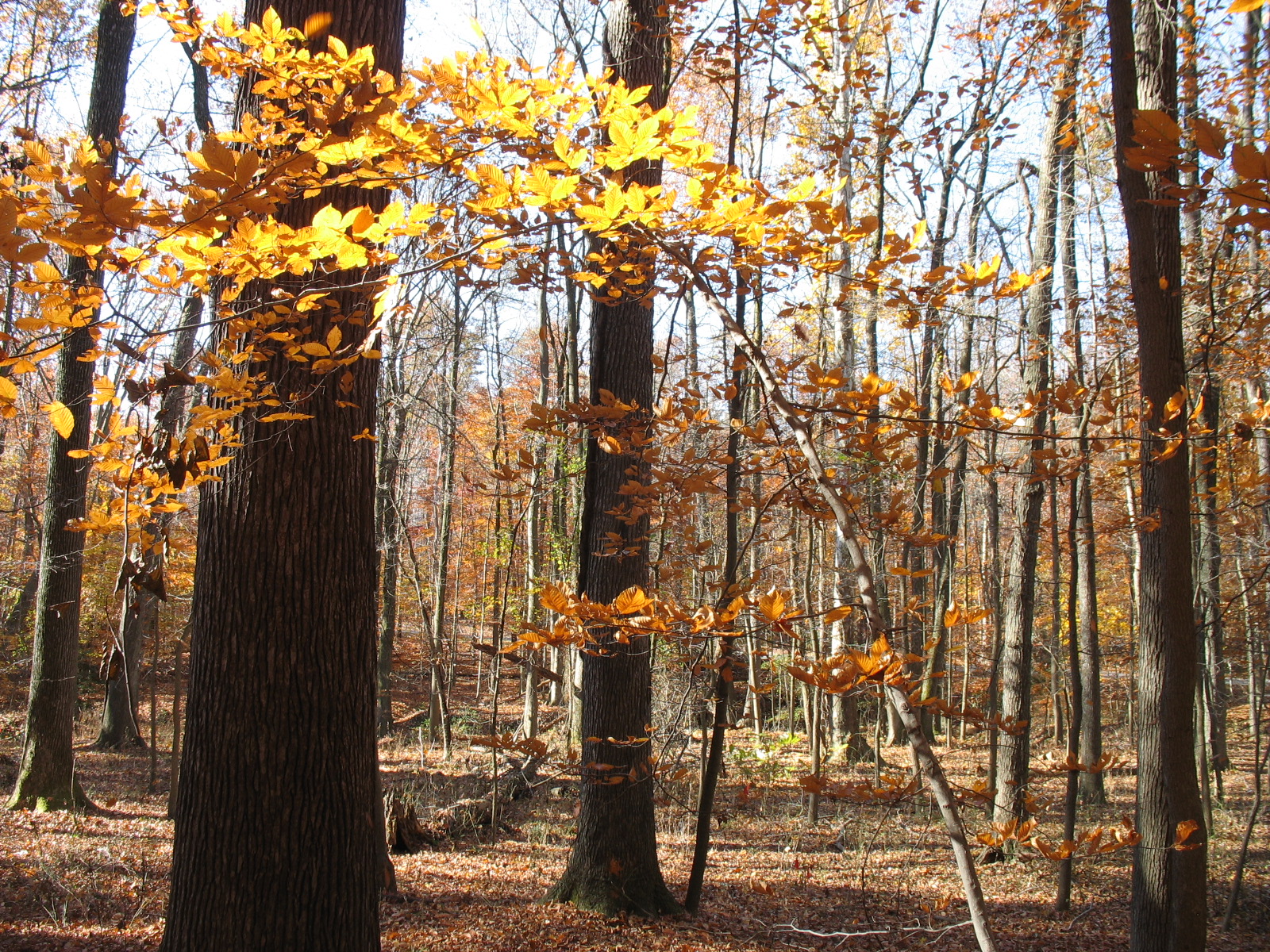
 Six-times more carbon dioxide (CO2) is removed each year by terrestrial photosynthesis than fossil fuel emissions. However, the carbon is mostly returned to the atmosphere by decomposition. We found a 3775-year-old ancient wood log buried 2 meters belowground that was preserved far beyond its expected lifetime. The wood had near-perfect preservation, with carbon loss less than 5% compared to a modern sample. The lack of decay is likely due to the low permeability of the compact clay soil at the burial site. Our observation suggests a hybrid nature-engineering approach for carbon removal by burying woody biomass in similar anoxic environments. We estimate a global sequestration potential of up to 10 gigatonnes CO2 per year with existing technology at a low cost of $30 to $100 per tonne after optimization. See Zeng et al. 2024 in Science Magazine and a Washington Post article and other media coverage listed on Altmetric.
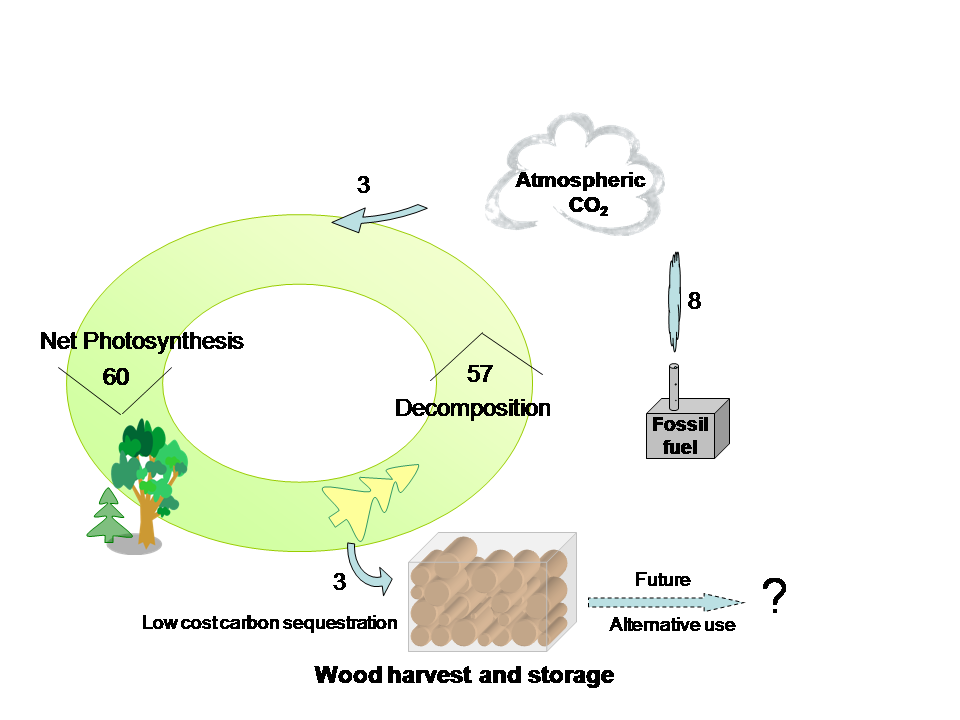
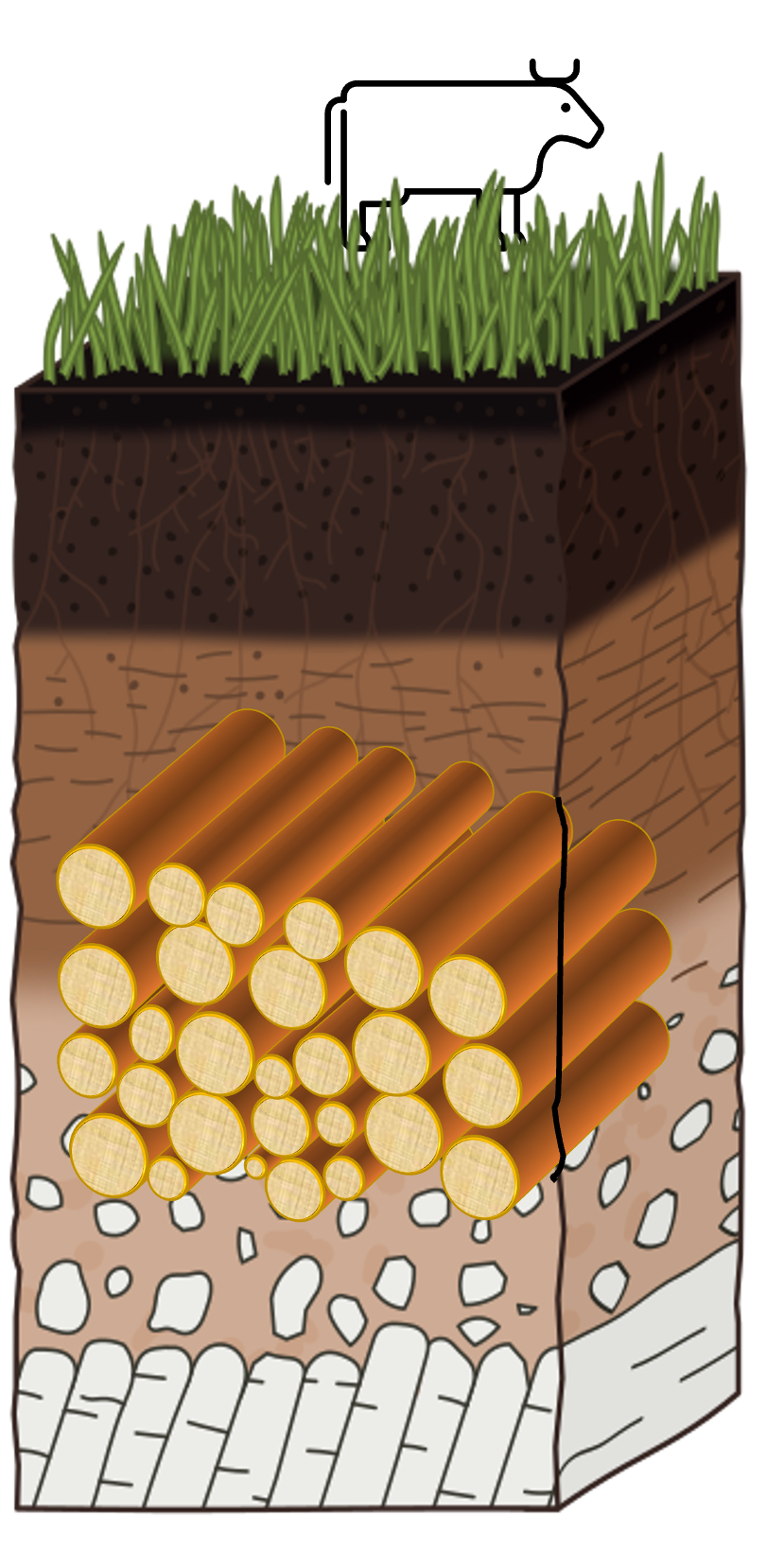 To keep Earth safe from dangerous climate change, a large amount of CO2 will need to be removed from the atmosphere and stored away permanently, via negative emissions technology (NET), for example, planting trees. But planting trees is not enough. The natural carbon cycle is in near balance. In an established forest, some trees absorb large quantity of CO2, but other trees die, decay and release carbon back into the atmosphere. The idea of Wood Harvesting and Storage (WHS) proposes management intervention by wood harvesting or wood residual collection, followed by storage in anoxic (oxygen-depleted), bone dry, or freezing cold conditions to prevent decomposition. The wood can be stored either underground (like this 3775-year old ancient log), aboveground, or underwater (such as the Black Sea). Because the forest as a whole is still maintained and continues to absorb CO2, the net effect is to remove CO2 from the atmosphere. The engineering structure to ensure long-durability storage is called Wood Vault. The technique is low tech, distributed, easy to monitor, safe, and reversible, thus providing an option in the 'toolbox' of climate mitigation and adaptation strategies. The technology is now being implemented by companies worldwide. See the original concept paper (Zeng, 2008), and Wood Vault science, engineering, and economics (Zeng and Hausmann, 2022), and In the News for media stories and updates.
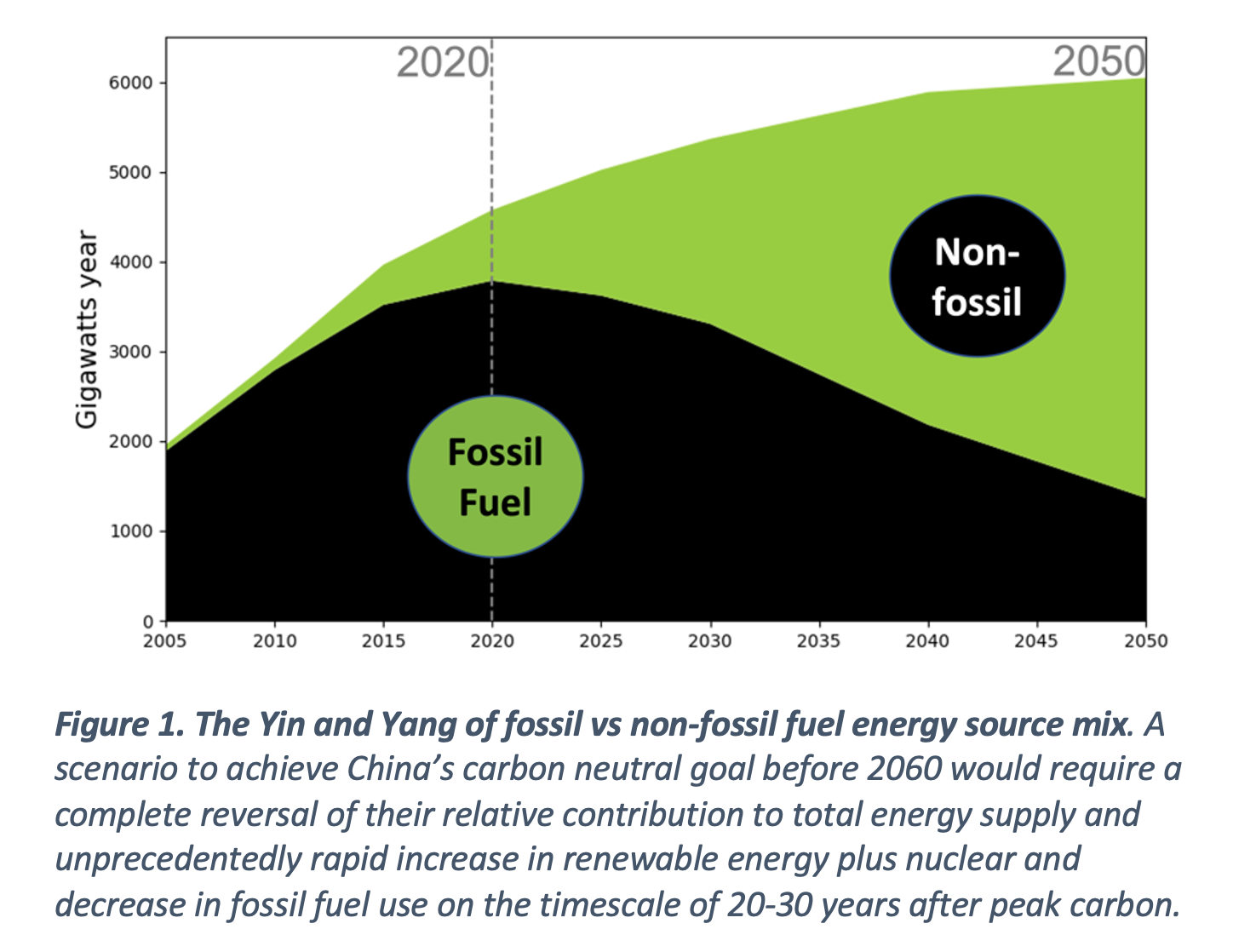 On 22 September 2020, within the backdrop of the COVID-19 global pandemic, China announced its climate goal for peak carbon emissions before 2030 and to reach carbon neutrality before 2060. This carbon-neutral goal is generally considered to cover all anthropogenic greenhouse gases. The planning effort is now in full swing in China, but the pathway to decarbonization is unclear. The needed transition towards non-fossil fuel energy and its impact on China and the world may be more profound than its reform and development over the past 40 years, but the challenges are enormous. Analysis of four representative scenarios shows significant differences in achieving the carbon-neutral goal, particularly the contribution of non-fossil fuel energy sources. The high target values for nuclear, wind, and bioenergy have approached their corresponding resource limitations, with solar energy being the exception, suggesting solars critical role. We also found that the near-term policies that allow for a gradual transition, followed by more drastic changes after 2030, can eventually reach the carbon-neutral goal and lead to less of a reduction in cumulative emissions, thus inconsistent with the IPCC 1.5C scenario. The challenges and prospects are discussed in the historical context of China socio-economic reform, globalization, international collaboration, and development. Zeng et al. (2022)
The iconic Mauna Loa CO2 record shows not only a long-term increase due to fossil fuel emissions and land use change, but also a prominent seasonal cycle whose amplitude is larger than annual fossil fuel emissions, and it has also been increasing over the last 5 decades. Pioneers including R. Bacastow and C. D. Keeling had pondered on these changes. Because the CO2 seasonal oscillations are largely due to the growth and decay of the biosphere, dominated by the Norhtern Hemisphere vegetation, they hypothesized that better vegetation growth due to warming in the high latitude regions and more CO2 'fertilization' may be the reason for the increase in the CO2 seasonal amplitude. In a Nature paper,Zeng et al. (2014) suggests yet another factor, the agricultural Green Revolution. At the height of the growing season, in major crop regions around the world such as the US midwest cornbelt and Eastern China, extraordinarily high photosynthsis rates draw down CO2 from the atmosphere, leading to a deeper and deeper minimum at the end of growing season. Some media coverage can be found here, including a Nature commentary. In a companion paper, Zhao and Zeng (2014) found that the IPCC AR5 carbon-climate models project this trend to continue into future.
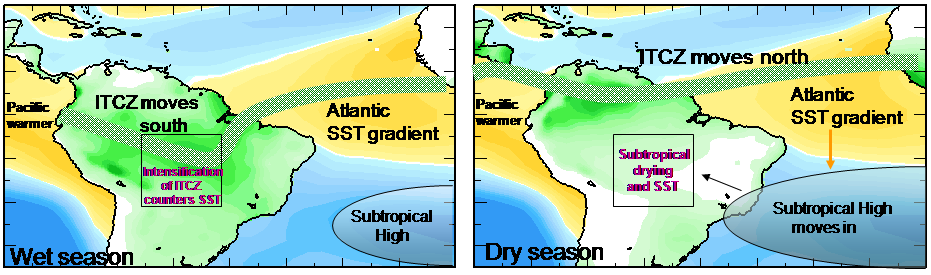 The fate of the Amazon rainforest will be determined by two key factors: trends of deforestation and climate change. The suggestion of a possible climate change induced forest dieback has raised considerable interest as well as controversy. We analyzed 24 IPCC model future climate projections under the A1B scenario and simulated their impacts with a dynamic vegetation model. Our results suggest that the core of the Amazon rainforest should remain largely stable as rainfall in the core of the basin is projected to increase in nearly all models. However, the periphery, notably the southern edge of Amazonia and further south into central Brazil (SAB), are in danger of soil moisture loss and vegetation change, driven by two main processes: (1) subtropical drying during its dry season due to a combination of circulation and SST changes, when vegetation needs water most even though the annual mean rainfall may not change significantly; (2) evaporative soil moisture loss in a warmer world. Southern Amazonia is currently under intense human influence as a result of deforestation and land use change. Should this direct human impact continue at present rates, added pressure to the region's ecosystems from climate change may subject the region to profound changes in the 21st century. Details can be found at Cook et al. (2012). Similar Atlantic SST gradient pattern has been shown to cause the severe 2005 Amazon drought (Zeng, et al., Best of the year 2008 at Environmental Research Letters).
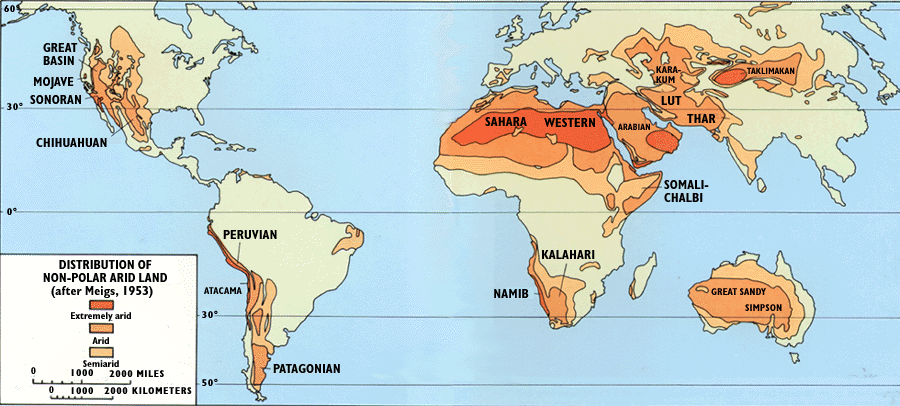 Many subtropical regions are expected to become drier due to climate change. This will lead to reduced vegetation which may in turn amplify the initial drying. Using a coupled atmosphere-ocean-land model with a dynamic vegetation component that predicts surface albedo change, here we simulate the climate change from 1901 to 2099 with CO2 and other forcings. In a standard IPCC-style simulation, the model simulated an increase in the world's "warm desert" area of 2.5 million km squared or 10% at the end of the 21st century. In a more realistic simulation where the vegetation-albedo feedback was allowed to interact, the "warm desert" area expands by 8.5 million km2 or 34%. This occurs mostly as an expansion of the world's major subtropical deserts such as the Sahara, the Kalahari, the Gobi, and the Great Sandy Desert. It is suggested that vegetation-albedo feedback should be fully included in IPCC future climate projections. Zeng and Yoon (2009)
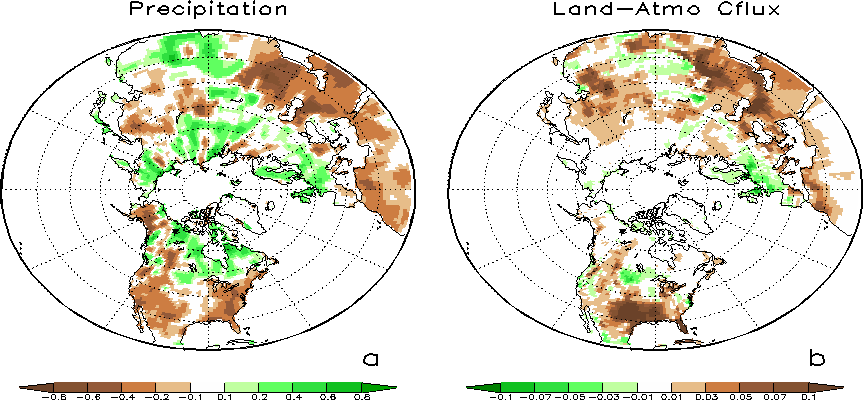 A rare drought occurred from 1998 to 2002 across much of the Northern Hemisphere midlatitude regions. Using observational data and numerical models, we analyze the impact of this event on terrestrial ecosystem and the global carbon cycle. The biological productivity in these regions were found to decrease by 0.9 PgC/y or 5% compared to the average of the previous two decades, in conjunction with significantly reduced vegetation greenness. The drought led to a land carbon release that is large enough to significantly modify the canonical tropically dominated ENSO response. This large CO2 source explains the consecutive large increase in atmospheric CO2 growth rate of about 2 ppmv/y in recent years, as well as the anomalous timing of events. Zeng, Qian, Roedenbeck and Heimann (2005).
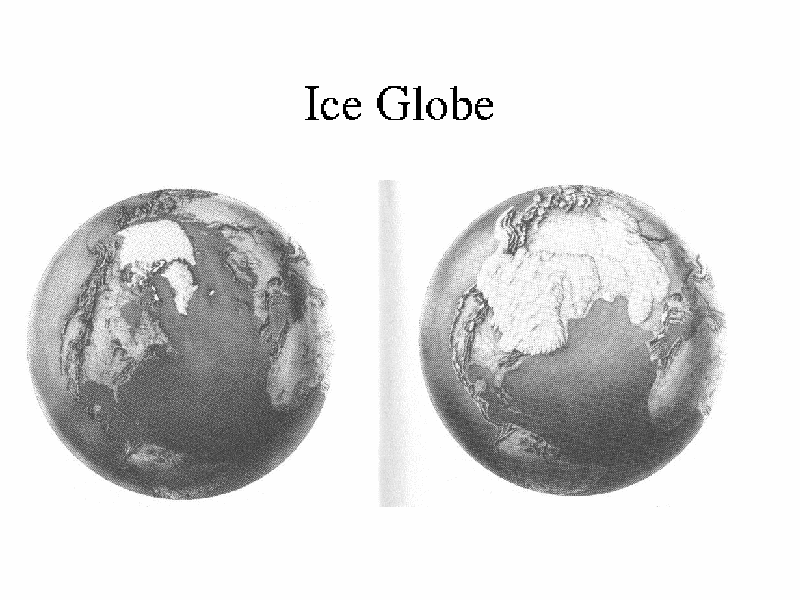 Only 21,000 years ago, large parts of the Northern Hemisphere were covered under giant icesheets. Today, the mystery of the glacial-interglacial cycles remains unsolved. Apart from important roles astronomical orbital forcing may play, it is becoming increasingly clear that CO2-climate interaction is a key component. Zeng (2003) hypothesized a mechanism in which organic carbon buried under the icesheets may be a `missing link' in the ice-age story. Zeng (2007) further proposed a mechanism where internally generated quasi-100ky cycles could be triggered by subglacial burial carbon release as large icesheets such as the Laurentide grow long and large enough and the basal melting ejects burial carbon into the atmosphere, thus starting a carbon-climate-icesheet feedback that could explain such as the deglaciation at Termination II.
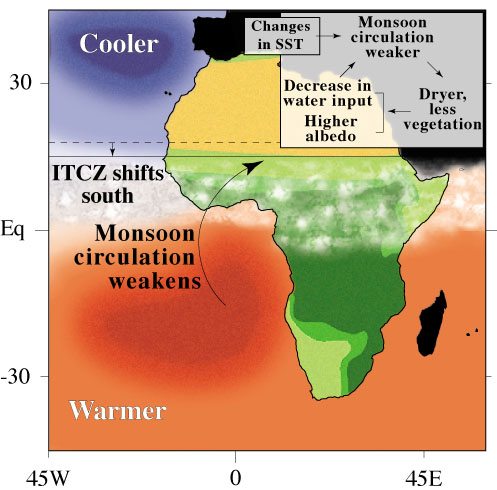 The Sahel, a semiarid region in West Africa between the Sahara desert and the Guinea coast rainforest, has experienced an unprecedented drought in recorded history since the late 1960s. The drought had a devastating impact on this ecologically vulnerable region and was a major impetus in the establishment of the United Nations Convention on Combating Desertification and Drought. In a perspective article in the journal Science, Zeng (2003) explains our current understanding of the problem, while Zeng et al. (1999) explores the relative roles of sea surface temperature, land and vegetation feedbacks. Additionally, a series of papers explore the nonlinear dyanmics of vegetation-atmosphere interaction in desert-forest transitions.
|
|
|
UM Home
| Directories
| Search
| Admissions
| Calendar |
